
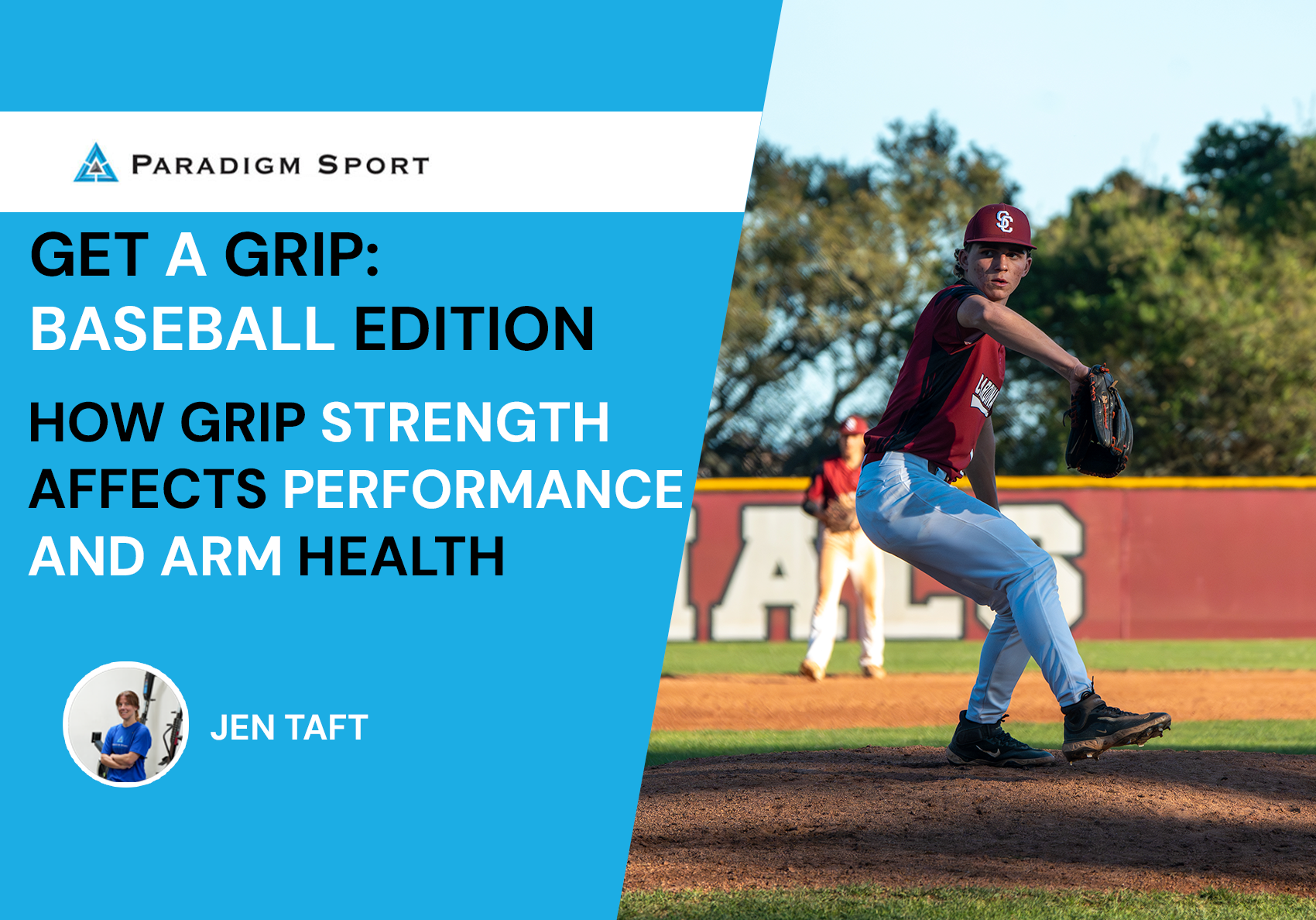
How grip strength affects performance and arm health
Hand and forearm strength plays a big role in baseball performance, on both the hitting
and pitching sides of the game. Understanding why it’s important, as well as how to
train it, may help you unlock another level within your game.
Let’s look at how grip strength impacts hitters:
· Bat control and power transfer
At the start of a swing, energy is created by the lower body interacting with the ground.
It then travels through the kinetic chain (lower body, hips, torso, arms) before passing
through the hands and to the bat. If there are any weak links in the chain, some energy
will be lost. The hand is the last link before the bat makes contact with the ball, and we
want to preserve as much energy as possible in order to maximize collision efficiency.
Strong hands and forearms can help prevent energy from leaking before contact.
· Barrel acceleration and stabilization
Higher bat speed yields higher exit velo, which increases the likelihood of hits. Having
the strength to handle higher torques and rotational velocities allows the bat to
accelerate faster and longer through the zone. Having the strength to stabilize the bat
during a swing leads to better contact by preventing unnecessary bat movement that
could result from an inability to keep the bat steady.
· Adjustability within the swing
Hitting off-speed pitches becomes a lot more manageable when you are strong enough
to make late adjustments in bat path or attack angle. This decreases the rate of mis-hit
balls and leads to better contact.
· Durability
Stronger muscles don’t fatigue as quickly. This means you can handle taking more
swings before technique breaks down—and getting in more reps means more
improvement. It also makes you more resilient to overuse stress, as less wear and tear
builds up during a session.
These elements all contribute to increasing the likelihood of successful outcomes at the
plate.
Now, let’s check out what grip strength means for pitchers:
· Ball velocity
If your hand is weak, energy can leak from the kinetic chain at the last moment (just like
hitting). The fingers are last thing to touch the ball before release, which means the
force they impart on the ball has a direct implication on pitch speed, spin rate, and
movement.
· Pitch control
Finger strength affects the pressure that is applied through the seams on the ball. This
pressure determines spin rate, spin efficiency on breaking balls, and the consistency of
your release.
· Arm health
The forearm flexor muscle group stabilizes the elbow and protects the UCL, as having
more strength in those muscles decreases stress on the UCL. Once fatigue sets in as
pitch counts rise, stronger forearm flexors help delay mechanical breakdowns that can
cause compensations that may lead to injury.
· Durability and endurance for performance
When grip strength decreases over the course of an outing due to fatigue, spin rate
drops and pitches flatten. Command typically decreases and mechanical
compensations may increase. Endurance and strength of finger muscles also affect
consistent ball release.
Health and performance are both strongly impacted by a pitcher’s grip strength. Next,
let’s look at the different types of grip strength so we can learn how each can be used to
help a baseball player.
The four types of grip strength and how they impact baseball players:
1 – Crushing: how hard you can squeeze something using the whole hand. This
provides stability to the hand, wrist, and arm through strength that involves maximum
high intensity gripping for shorter durations, like during a trap bar deadlift or dumbbell
row. The forearm flexor muscle group is heavily used here, making crushing grip
important for elbow protection.
2 – Pinching: ability to squeeze something using just the thumb and fingers (without
the rest of the hand). The forearm flexors and small muscles of the hand and fingers are
used here. Plate pinch variations and rock wall climbing are examples of ways to work
on pinching strength.
3 – Supporting/Holding: ability to hold on to something with the whole hand. The
difference between this and crushing strength is that supporting strength is focused on
endurance and resisting fatigue, not maximum force. Hangs, farmer/suitcase carries,
pull ups, and any exercises that involve holds for time are great ways to train this. The
forearm flexors and extensors are talking on the bulk of the demands here.
4 – Extension: opening the hand (anti-flexion). Often forgotten, extension work
opposes the gripping muscles by using the forearm extensor group and preventing
imbalances, which is key for elbow health. It’s extra important for pitchers, since it works
on fine motor control of the fingers. Band resistance, manual resistance, finger extensor
training devices, single-finger plate lifts, reverse dumbbell wrist curls, and rice bucket
drills are all exercises that can help keep hand and forearm muscle groups balanced.
Putting it All Together
Adding grip exercises to your strength program is a great way to both improve your
performance and build up protection for your arm. It’s also never too early to
start—youth athletes can see benefits just like more experienced athletes.
While supplementing your routine with targeted exercises is beneficial, keep in mind
that you’ve likely been working on grip strength without even realizing it. Trap bar
deadlifts, dumbbell rows, farmer carries, and any other exercise that involves holding
heavy weight will help train grip. However, most of these exercises will utilize
supporting and crushing grip strength. Pinching grip strength tends to be the most
neglected, so it’s a good idea to address it. Lastly, extension strength can be beneficial
for pitchers and maximizing their arsenals.
Adding two sets of two grip exercises from different categories into each lift is a good
place to start. Just be cautious about doing heavy grip work within a day or so before a
high intensity throwing session (you don’t want your forearm to be fatigued going into a
game or bullpen!). Likewise, grip work directly before hitting could also have a negative
impact on your swing.
Hopefully you now have a better understanding of how grip strength affects on-field
performance and overall arm health. While it is a small part of a comprehensive training
program, it provides a lot of value and can be a difference-maker.
Have any more questions? Feel free to reach out to us!
-Jen

