
Hey,
If you’re serious about playing college baseball, you’re probably already doing a lot of the right things.
You’re lifting.
You’re hitting.
You’re throwing bullpens.
You’re working on your speed.
You’re coming into Paradigm and grinding when you’d probably rather be sitting on the couch playing video games.
That’s good.
But here’s the question I want you to ask yourself:
Are you working just as hard when you leave the gym?
Because there’s one area where I see a lot of young baseball players missing the easiest opportunity to get better.
Nutrition.
And honestly, it’s a little crazy.
You’ll spend an hour working on your swing, but then go home and eat a bag of chips for dinner.
You’ll throw a great bullpen, but forget to eat for the next five hours.
You’ll crush a workout, then grab whatever is easiest because you’re “not that hungry.”
You’re doing the hard stuff.
But you’re missing one of the easiest things.
You have to pick up the fork.
You can’t build a bigger, stronger athlete without food
Think about it this way.
You can have the best training program in the world.
You can have great coaches.
You can have the perfect lifting program.
You can throw 95% of your bullpens with great intent.
But if you aren’t giving your body enough food and nutrients, you’re making it much harder for your body to actually adapt to all that work.
Your body needs fuel to train.
It needs protein to help repair and build muscle.
It needs carbohydrates to give you energy.
It needs healthy fats to support your body.
And it needs enough total food to help you grow.
This becomes especially important when you’re a young athlete.
You’re not just training.
You’re growing.
You’re going to school.
You’re playing games.
You’re practicing.
You’re lifting.
You’re throwing.
You’re hitting.
That’s a lot of work.
And all of that requires fuel.
The best athletes leave no stone unturned
One thing I’ve noticed from working with professional athletes is that the best ones don’t look for shortcuts.
They leave no stone unturned.
They take care of the little things.
They get their work in.
They recover.
They sleep.
They take care of their bodies.
And yes, they eat.
Their nutrition isn’t perfect every single day. They’re human.
But they understand that what they put into their body matters.
That’s a mindset.
If you want to play college baseball, you have to start thinking like someone who wants to play college baseball.
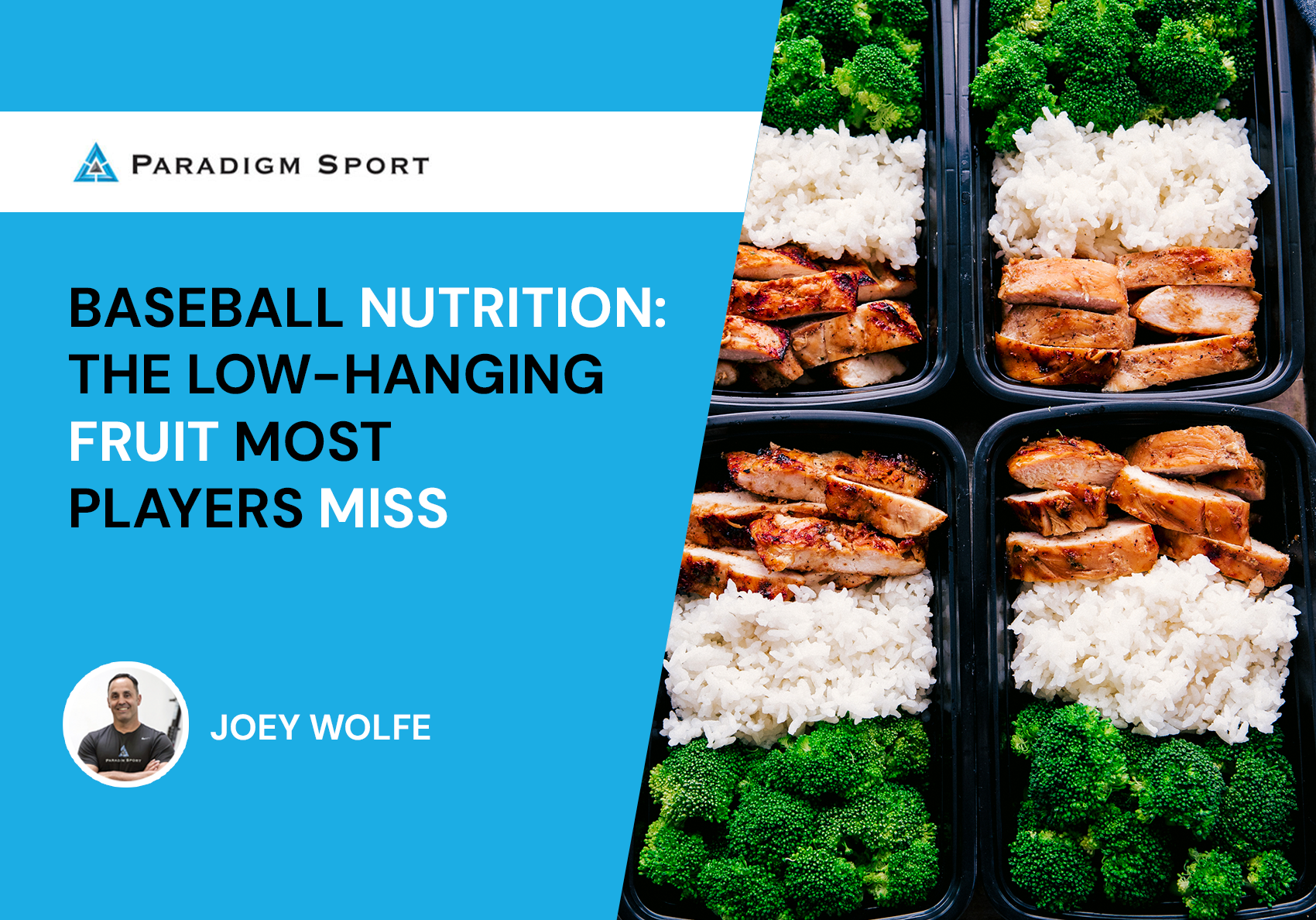
That doesn’t mean you have to eat chicken and broccoli out of a Tupperware container every three hours for the rest of your life.
It means you start asking:
“What does my body need to do the job I’m asking it to do?”
That’s a much better question.
Here’s where I’d start
You don’t need to completely change your diet tomorrow.
Start with three simple things.
1. Eat more often
If you’re a growing athlete, there’s a good chance you simply aren’t eating enough.
Try to eat something every 3-4 hours during the day.
That could be breakfast, lunch, a snack, dinner and another snack.
Don’t overcomplicate it.
A sandwich.
Greek yogurt and fruit.
Eggs and toast.
A smoothie.
Chicken and rice.
A burrito.
Whatever works.
The goal is to give your body fuel throughout the day instead of asking it to run on empty.
2. Put protein in every meal
Protein helps your body repair and build muscle.
So make it easy.
When you sit down to eat, ask yourself:
“Where’s my protein?”
Eggs.
Chicken.
Turkey.
Beef.
Fish.
Greek yogurt.
Cottage cheese.
Milk.
Whatever you like.
You don’t need to make nutrition complicated. Start by making sure protein shows up consistently.
3. Make eating part of your training
This is probably the biggest one.
Don’t wait until you’re starving.
Don’t leave it up to chance.
If you have training at 4:00, know what you’re eating before and after.
Pack something in your backpack.
Have food ready when you get home.
If you’re going to be at a tournament all day, bring food with you.
Make it part of your routine.
Because here’s the truth:
If nutrition isn’t planned, convenience usually wins.
And convenience doesn’t always make you a better baseball player.
Parents, you matter here too
If you’re a young athlete reading this, don’t think you have to figure all of this out by yourself.
Your parents are part of the team.
They can help by keeping good food in the house.
They can help by cooking.
They can help by making sure you have food packed for school and tournaments.
And sometimes they can help by reminding you to eat when you’re busy.
Parents, your athlete can’t eat food that isn’t in the house.
You don’t have to become a full-time nutritionist.
Just make it easier for your athlete to make good choices.
I struggle with this too
I’m not writing this from some perfect nutrition pedestal.
I’ve played professional baseball. I’ve trained for a long time. I know what I’m supposed to do.
And I still struggle with it.
There are days when I’m great.
Sometimes I’m good for weeks or even months.
Then life gets busy.
Preparing meals gets old.
Thinking about what I’m going to eat gets exhausting.
And sometimes I’d rather just eat the thing that’s easiest.
That’s normal.
The goal isn’t perfection.
The goal is consistency.
You don’t need to eat perfectly for the next 10 years.
You need to make good nutrition a lifestyle.
Because that’s what we’re really trying to teach you at Paradigm.
We’re not just trying to make you a better baseball player.
We’re trying to teach you how to do the things that matter, even when they’re hard, boring or inconvenient.
If you want something badly enough, you have to make the work a priority.
And compared to throwing 100 pitches, taking 100 swings or grinding through a hard lift…
Eating another meal isn’t exactly the hardest thing you’ll do today.
So pick up the fork.
Fuel your body.
Recover.
Come back tomorrow.
And keep getting better.
That’s how you start separating yourself.
One meal. One workout. One day at a time.
Joey

